Every parent wants their child to have a strong start in life.
But what does a strong start actually look like?
Is it learning to recite the alphabet before everyone else? Finishing more worksheets? Memorising multiplication tables sooner? Scoring the highest marks in class?
Those achievements matter, but childhood education has a much bigger job.
The early years are also when children begin developing confidence, concentration, curiosity, independence, communication skills, responsibility and the ability to solve problems without immediately waiting for an adult to provide the answer.
That is where the educational approach chosen by parents becomes important.
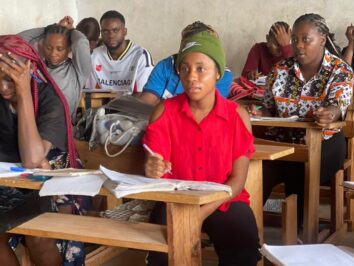
In Damas, Yaoundé, Akwi Montessori School offers families an education built around a different starting point: the child.
Rather than expecting every learner to absorb information in exactly the same way and at exactly the same speed, the Montessori approach creates an environment where children can explore purposefully, learn through hands-on activities and gradually take greater responsibility for their own development.
For parents considering nursery or primary education for the 2026/2027 academic year, here is a closer look inside the child-centred learning experience at Akwi Montessori School (AMS).
What Does “Child-Centred Learning” Really Mean?
“Child-centred” has become a popular expression in education, but it can easily be misunderstood.
It does not mean that children control the school.
It does not mean there are no rules.
And it certainly does not mean children are left alone to learn whatever they want without guidance.
In Montessori education, child-centred learning means designing the learning environment around how children develop.
The Association Montessori Internationale (AMI) describes Montessori environments as carefully prepared spaces containing accessible furniture, different work areas and specially designed materials. Children engage in hands-on activities after introductions from trained adults and progressively learn through individual, collaborative and peer-to-peer work.
There is freedom, but that freedom operates within clear limits.
There are choices, but the choices are purposeful.
There are teachers, but their role extends beyond standing in front of a class delivering information.
The result is an environment designed to help a child become an active learner rather than a passive recipient of lessons.
At Akwi Montessori School, Learning Starts With the Child
One of the first differences parents may notice in a Montessori classroom is the role of the adult.
At AMS, teachers are expected to spend significant time observing learners rather than continuously dominating classroom activity. The school explains that children progressively learn to select activities, work with materials and return them independently.
That seemingly simple process develops several abilities simultaneously.
A child has to make a decision.
A child has to concentrate.
A child has to handle materials appropriately.
A child has to complete a process.
A child has to take responsibility for restoring the environment afterwards.
Learning therefore becomes more than obtaining a correct answer.
It becomes practice in thinking, choosing, doing and taking responsibility.
And those are abilities children will need long after primary school.
Learning by Doing Instead of Only Listening
Young children naturally want to touch, move, investigate, repeat and experiment.
Montessori education uses that instinct rather than constantly trying to suppress it.
In a Montessori environment, concrete experience often comes before abstraction. Children manipulate carefully selected materials that help them experience concepts physically before progressing toward more symbolic or abstract understanding.
Consider the difference.
A child can be told about size.
Or the child can physically arrange objects according to size and discover the relationship.
A child can memorise a mathematical rule.
Or the child can first manipulate materials that make the numerical relationship visible.
A child can hear an adult explain responsibility.
Or the child can practise carrying, organising, cleaning, returning and caring for materials every day.
Both instruction and knowledge are important.
But when children experience what they are learning, understanding can become deeper and more meaningful.
Practical Life Is Serious Learning
Adults sometimes look at Montessori Practical Life activities and wonder:
Why is my child doing this at school?
Perhaps a child is pouring.
Sorting.
Folding.
Cleaning.
Carrying.
Fastening.
Organising.
Serving.
Putting objects away.
At first glance, these activities may appear less important than mathematics or reading.
They are not.
Practical Life activities are designed to help children develop coordination, concentration, independence, order and confidence. For children aged 3–6, AMI identifies Practical Life as one of the central areas of the Montessori environment alongside Sensorial development, language, mathematics, geography, biology, science, music and the arts.
The value becomes clearer when you think beyond the immediate activity.
A child who carefully completes a sequence is strengthening concentration.
A child who learns to handle objects independently builds confidence.
A child who cleans up afterwards practises responsibility.
A child who repeats a task improves coordination and persistence.
The activity may look simple.
The development happening underneath it is not.
A Strong Start Begins With Independence
There is a phrase that captures one of the most recognisable goals of Montessori education:
“I can do it myself.”
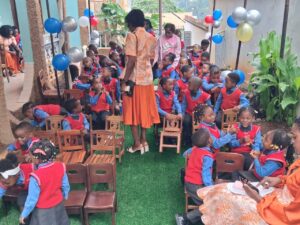
Akwi Montessori School explicitly identifies independence as one of the developmental priorities of its toddler programme, which caters for children from approximately 30 months to 3 years. The programme also focuses on language, cognitive, emotional, social and motor development.
Independence does not mean abandoning a child to struggle.
It means giving children opportunities to do what they are increasingly capable of doing instead of automatically doing everything for them.
There is a major difference.
Imagine two children preparing for school.
One waits while an adult carries the bag, arranges every belonging, solves every small problem and gives instructions at every step.
The other receives appropriate help but is progressively encouraged to organise belongings, make simple choices, attempt tasks and correct manageable mistakes.
Over time, the second child is developing more than practical ability.
The child is receiving a powerful internal message:
I am capable.
That confidence can influence how children approach academic work, relationships and future challenges.
The Toddler Years: Building Foundations Before Formal Schooling
Parents sometimes feel pressure to turn toddler education into an academic race.
How many letters can the child recognise?
Can they count?
Can they write their name?
But between approximately two and three years of age, development is happening across many interconnected areas.
Akwi Montessori School's toddler programme is designed as a transition environment for children approaching Nursery age. AMS highlights six major areas:
- Language development
- Cognitive development
- Emotional development
- Social development
- Motor development
- Independence
Children are introduced to age-appropriate Montessori materials and can choose among activities suited to their developmental interests and needs.
This period therefore becomes preparation not merely for school, but for learning itself.
A child learns how to engage.
How to communicate.
How to move purposefully.
How to interact.
How to make simple decisions.
And eventually, how to do more without constant adult intervention.
Ages 3–6: Where Curiosity Becomes Structured Discovery
The 3–6 Montessori environment is often where the philosophy becomes most visible.
Children at this stage are intensely curious.
They want to know names.
Numbers.
Shapes.
Sounds.
Why things happen.
How things work.
Where things belong.
Instead of treating that curiosity as a distraction from the curriculum, Montessori education turns it into a pathway toward the curriculum.
AMI explains that the 3–6 environment includes activities in Practical Life, Sensorial learning, spoken language, writing, reading and mathematics, alongside geography, history, biology, science, music and art.
The child is learning academically.
But they are simultaneously developing concentration, reasoning, movement, language, imagination and sociability.
That is why Montessori education is often described as educating the whole child rather than concentrating only on academic recall.
Sensorial Learning: Helping Children Understand the World
Before young children can work confidently with abstract concepts, they first need meaningful experiences with the world around them.
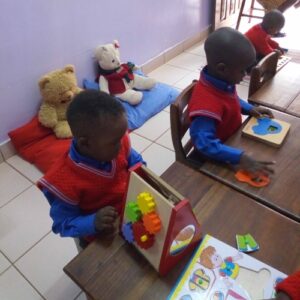
Montessori Sensorial activities help children refine how they notice differences and relationships involving characteristics such as dimension, form, texture and other sensory properties.
This process supports a child's ability to classify, compare, organise and recognise patterns.
Those abilities later become useful across many academic areas.
Sorting and discrimination can support mathematics.
Listening carefully supports language.
Observation supports science.
Order supports reasoning.
Montessori materials therefore are not simply attractive classroom objects.
They are designed to give children carefully structured opportunities for discovery.
Language Development That Goes Beyond Memorising Words
Language is at the centre of childhood development.
It allows children to communicate needs, build relationships, understand instructions, organise their thoughts and eventually access virtually every academic subject.
The Montessori 3–6 programme progresses through spoken language toward writing and reading, with materials and activities supporting children as their capabilities develop.
At Akwi Montessori School, there is also an important local dimension.
AMS describes itself as an Anglo-Saxon institution, while French is taught throughout the school in recognition of Cameroon's bilingual environment.
For families in Yaoundé, that combination can be particularly relevant.
Children receive an English-based educational experience while also encountering French as one of Cameroon's two official languages.
Mathematics Children Can See and Touch
For many adults, mathematics brings back memories of rules written on a board and procedures memorised for examinations.
Montessori begins differently.
Children first work with concrete experiences that make quantities and relationships visible before they are expected to operate entirely at the abstract level.
The philosophy behind this is straightforward:
understanding should support memorisation, not simply follow it.
Children can manipulate, compare, repeat and gradually recognise mathematical patterns.
As confidence grows, physical experiences can give way to increasingly abstract mathematical thinking.
This progression helps explain why Montessori materials are carefully sequenced rather than simply placed in the classroom as educational toys.
The Teacher Guides Without Taking Over
Good child-centred education does not reduce the importance of the teacher.
It makes the teacher's skill even more important.
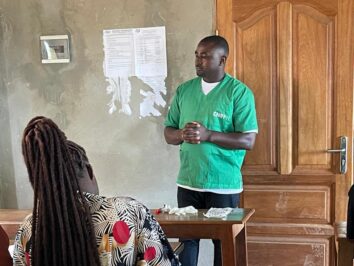
AMI describes the Montessori educator as a guide or facilitator who observes each child's development, recognises individual needs and introduces appropriate materials when the learner is ready.
That requires judgement.
When should the teacher demonstrate?
When should the teacher encourage?
When does a child genuinely need help?
And when would stepping in too quickly prevent the child from discovering a solution independently?
At AMS, teachers come from conventional teacher-training backgrounds and receive foundational Montessori training before the academic year. The school also reports organising further training sessions during the year.
For parents comparing schools, teacher preparation is therefore something worth asking about—not merely classroom appearance.
Individual Attention Matters
Children do not develop at identical speeds.
One may suddenly become fascinated by reading.
Another may show strong mathematical reasoning.
One may need more time to become socially confident.
Another may need an additional challenge.
Akwi Montessori School currently reports an approximate average of seven pupils per teacher across the school.
A lower pupil-to-adult ratio can make careful observation easier.
But Montessori adds an important principle: teachers are not supposed to use their presence to make children unnecessarily dependent on adults.
The goal is a balance between support and independence.
Enough guidance for children to progress.
Enough freedom for children to develop their own capabilities.
What Happens When Children Reach Primary School?
Some parents still associate Montessori exclusively with Nursery.
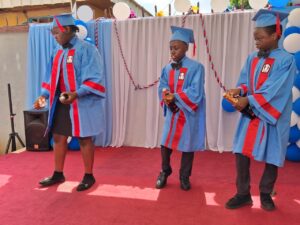
Akwi Montessori School extends its programme beyond preschool.
AMS admits children into:
- Toddlers: approximately 2½–3 years
- Montessori Nursery: 3–6 years
- Elementary: 6–12 years
Children can therefore continue into Lower and Upper Elementary.
This matters because Montessori changes as the child develops.
A six-year-old does not learn exactly like a three-year-old.
As children mature, reasoning, imagination, research, collaboration and increasingly complex academic work become more important.
The principle remains child-centred, but the level of intellectual challenge evolves with the learner.
Montessori Education Without Ignoring Cameroon’s Examination System
A common question from parents is:
Will my child be ready for conventional examinations later?
That is a legitimate concern in Cameroon.
Akwi Montessori School says it deliberately introduces assessments as children mature because learners may eventually transition into the conventional Cameroonian system.
Eligible Elementary pupils can be prepared for the Government Common Entrance Examination and First School Leaving Certificate.
This is a significant feature of the AMS model.
Parents are not necessarily being asked to choose between child-centred development and preparation for Cameroon's academic system.
AMS seeks to build Montessori skills while also preparing children for the realities they may encounter later.
What About Children Transferring From Traditional Schools?
A child does not necessarily have to begin Montessori as a toddler.
AMS states that children from traditional schools may be admitted following an assessment intended to determine an appropriate level.
That is useful for parents who discover Montessori later.
There may, however, be an adjustment period.
A child accustomed to being told exactly what to do at every moment may initially find greater responsibility unfamiliar.
Likewise, a child accustomed mainly to memorisation may need time to adapt to practical exploration and independent work.
This does not mean the child cannot adapt.
It means parents and educators should allow time for a new learning culture to become familiar.
Culture Is Part of Education
A child-centred education should not isolate children from the society in which they are growing up.
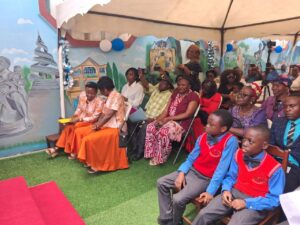
Akwi Montessori School's published event history includes activities designed to connect learning with culture and real-world experiences.
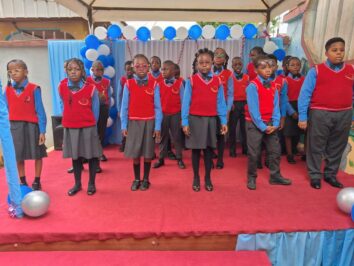
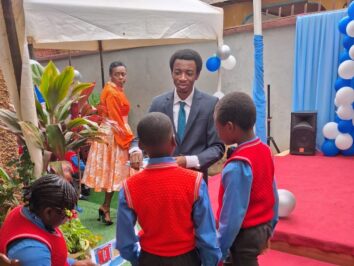
Its Cultural Day, for example, celebrates traditions associated with Cameroon's major cultural zones. The school's gallery also describes practical experiences including a cinema-related learning outing and a barbecue event where pupils participated in preparation and cooking.
These experiences illustrate something important about Montessori philosophy:
the world outside a textbook can also be a classroom.
Children learn culture by experiencing it.
Responsibility by practising it.
Collaboration by participating in it.
And confidence by being trusted to contribute.
The Prepared Environment: Why Classroom Design Matters
Walk into a properly prepared Montessori classroom and you should notice that much of the environment is designed around the child.
Materials are accessible.
There are places for different kinds of work.
Order is visible.
Objects have purposes.
The learner should increasingly be able to navigate the environment without needing an adult for every small action.
AMI explains that Montessori classrooms use accessible furniture and materials to support concrete exploration and self-directed learning. Logical limits remain in place while the environment supports independence, confidence, self-discipline, respect and social connection.
This matters because environments influence behaviour.
A classroom that constantly tells a child, “Don't touch; wait for the adult,” produces a different experience from one that says:
“These materials are here for you. Learn how to use them responsibly.”
Mistakes Are Part of Learning
Children need opportunities to be wrong safely.
That is difficult when every activity is immediately judged by an adult.
Many Montessori materials incorporate what the method calls a control of error—features that allow learners to notice and correct mistakes through the activity itself. AMI explains that this feedback supports refinement through trial, repetition and discovery.
That creates a healthier relationship with mistakes.
Instead of every error producing:
“Teacher, is this correct?”
the child begins asking:
“What can I change?”
That shift matters.
The ability to identify a problem, attempt a solution and try again is useful in mathematics.
It is also useful in adulthood.
Independence Does Not Eliminate Community
Montessori is sometimes mistakenly portrayed as children working alone all day.
That is incomplete.
The prepared environment also supports collaboration, peer-to-peer learning and social relationships.
Children learn that individual freedom operates within a community.
They have responsibilities toward materials.
Toward other learners.
Toward shared spaces.
They learn to wait, collaborate, communicate and respect the work of others.
A truly child-centred environment therefore is not simply about me.
It gradually teaches children how to become capable individuals who can function responsibly with others.
Parents Are Part of the Montessori Experience
What happens at home can either reinforce or constantly contradict what a child experiences at school.
AMS encourages parents to communicate with teachers and provides opportunities for parent information sessions. Parents may also arrange appointments to observe their children at school.
Parents do not need to purchase an entire collection of Montessori materials to support the approach.
Some of the most valuable changes are simple.
Allow your child to carry manageable belongings.
Give them time to dress themselves.
Provide age-appropriate household responsibilities.
Place some everyday items where children can safely reach them.
Let them make sensible choices.
Allow manageable consequences.
Resist correcting every mistake immediately.
Ask questions instead of always providing answers.
Most importantly, do not confuse helping with doing everything for the child.
Sometimes the more loving response is giving them enough time to try.
What Parents Should Look for During a School Visit
A website can introduce a school.
A flyer can attract attention.
But a school visit tells parents much more.
If you are considering Akwi Montessori School for the 2026/2027 academic year, observe carefully.
Ask yourself:
Do the children appear purposefully engaged?
Can they access learning materials themselves?
Are classrooms organised and child-friendly?
How do teachers speak to children?
Are children encouraged to think before adults intervene?
How does the school manage discipline and boundaries?
How are academic progress and development communicated to parents?
How are children prepared for national examinations?
How does AMS support a child transferring from conventional education?
Choosing a school should never be based solely on attractive premises.
Parents should understand the educational culture their child will experience every day.
Admission to Akwi Montessori School: What New Parents Should Expect
AMS accepts applications throughout the year.
For new pupils, the published admission procedure begins with pre-registration. The school then arranges a visit so staff can meet the child, introduce the Montessori environment and assess readiness. New parents are also expected to participate in an interactive meeting with the Head of School so both sides can discuss expectations.
Admission decisions consider the child's visit, parent interview and the needs of existing classes, including pupil-to-teacher ratios and special educational requirements.
That is a thoughtful process because selecting a school should work both ways.
Parents need to determine whether they believe in the school's approach.
The school also needs to understand the child and family it may be welcoming.
A Note on 2026/2027 Fees and Resumption Information
Parents researching AMS online should pay close attention to the academic year attached to information they find.
At the time of this search, the publicly accessible pricing page on the school's website is still labelled for the 2025/2026 academic year.
For that reason, parents seeking admission for 2026/2027 should confirm the new fee structure, payment arrangements, resumption date and registration requirements directly with Akwi Montessori School rather than assuming that the previous year's figures remain unchanged.
This is particularly important before making payments based on screenshots or forwarded information from previous academic years.
A Note on 2026/2027 Fees and Resumption Information
Parents researching AMS online should pay close attention to the academic year attached to information they find.
At the time of this search, the publicly accessible pricing page on the school's website is still labelled for the 2025/2026 academic year.
For that reason, parents seeking admission for 2026/2027 should confirm the new fee structure, payment arrangements, resumption date and registration requirements directly with Akwi Montessori School rather than assuming that the previous year's figures remain unchanged.
This is particularly important before making payments based on screenshots or forwarded information from previous academic years.
Is a Child-Centred Education Worth It?
There is an understandable temptation to judge education only by what can be measured immediately.
What mark did the child score?
How many pages did they write?
How many words can they spell?
How quickly can they calculate?
Those things matter.
But some of the most important outcomes of childhood education appear gradually.
The confidence to speak.
The patience to concentrate.
The courage to try.
The discipline to finish.
The humility to correct a mistake.
The curiosity to ask why.
The independence to begin without waiting to be pushed.
The respect required to work alongside others.
Montessori education is designed to develop academic ability within that wider picture of human development. AMI describes the approach as supporting children's intellectual capabilities alongside social, emotional and practical development, with the aim of developing motivated and independent learners.
For parents, that raises an important question:
Are you choosing a school simply to prepare your child for the next class—or are you choosing an environment that is helping prepare your child for life?
Why Akwi Montessori School Deserves a Closer Look in 2026/2027
Akwi Montessori School has operated in Yaoundé since 2007, when it was founded by Prof. Estella Tembe-Fokunang after her Montessori training.
Today, the school offers an educational pathway from toddlers through Nursery and Elementary, combines Montessori principles with preparation for Cameroon's national academic system, teaches French alongside its Anglo-Saxon programme and maintains a strong emphasis on independence.
What makes that combination interesting is not one single feature.
It is the philosophy connecting them.
Children are expected to learn.
But also to participate.
To think.
To explore.
To communicate.
To contribute.
And progressively to become capable of doing more for themselves.
For a parent searching for a Montessori nursery or primary school in Yaoundé, that is worth experiencing firsthand.
Frequently Asked Questions About Akwi Montessori School
What ages does Akwi Montessori School accept?
AMS admits toddlers from approximately 2½ years, Montessori Nursery pupils from 3–6 years, and Elementary pupils from 6–12 years.
Is Akwi Montessori School only a Nursery school?
No. AMS provides both Nursery and Primary/Elementary Montessori education.
Can children transfer to AMS from another school?
Yes. The school states that pupils from conventional schools may be assessed and placed at an appropriate level.
Does AMS prepare children for Cameroonian national examinations?
Eligible Elementary learners may be prepared for the Government Common Entrance Examination and First School Leaving Certificate.
Is French taught at Akwi Montessori School?
Yes. AMS is an Anglo-Saxon institution, but French is taught throughout the school.
Can parents visit before enrolling?
Yes. A school visit forms part of the new-pupil admission procedure, followed by an interactive meeting with the Head of School for prospective parents.
Is registration open only at the beginning of the year?
AMS states that applications are accepted throughout the year, although admission remains subject to its assessment and class requirements
Also read Cameroon Montessori Association – CAMMOAS
Give Your Child More Than a Place in a Classroom
Children spend thousands of hours at school.
Those hours should do more than keep them occupied between morning drop-off and afternoon pickup.
They should help children discover what they are capable of.
At Akwi Montessori School, the child-centred philosophy begins with a simple but demanding idea:
Children can do more when adults create the right environment, provide appropriate guidance and give them room to grow.
That means learning to read and calculate.
But also learning to choose.
To concentrate.
To communicate.
To solve.
To care.
To respect.
To persevere.
And eventually to stand confidently on their own.
For families exploring school admission in Yaoundé for the 2026/2027 academic year, Akwi Montessori School offers something worth considering: not simply a different classroom, but a different way of seeing the child.
Take the Next Step
If you are looking for a Toddler, Nursery or Elementary school in Yaoundé and want to understand whether Montessori education is right for your child, arrange a visit and experience the learning environment yourself.
Akwi Montessori School
Maetur, Damas – Nsimeyong III
Yaoundé, Cameroon
Explore Akwi Montessori School and pre-register your child
Give your child a stronger start—one built on knowledge, confidence, independence and a lifelong love of learning.