Why Parents Are Choosing Montessori Education at Akwi Montessori School Yaoundé for Their Children? For many families in Yaoundé, preparing for a new school year means more than buying uniforms, notebooks and school supplies. The bigger decision is choosing an environment where a child will feel secure, become confident, develop strong academic foundations and gradually learn how to think and act independently.
As the 2026/2027 academic year in Cameroon approaches, this is one reason Montessori education is attracting the attention of parents looking beyond conventional classroom routines. At Akwi Montessori School (AMS) in Damas, Yaoundé, learning is built around the child—not simply around a timetable, a textbook or an examination.
Founded in 2007 by Prof. Estella Tembe-Fokunang, Akwi Montessori School has developed a Montessori programme adapted to the realities of children growing up and studying in Cameroon. The school admits children from the toddler stage through Nursery and Elementary, providing families with the possibility of continuity during some of the most important years of childhood development.
For parents currently considering schools for the new academic year, here is what makes the Akwi Montessori experience worth understanding.
School Resumption Is a Fresh Start—Not Just Another Academic Year
Every new school year comes with expectations. Parents want better results, teachers want progress, and children return with new interests, abilities and challenges.
But education during childhood should accomplish more than moving a learner from one class to another.
A strong early education should help a child communicate confidently, solve problems, interact respectfully with others, take responsibility, concentrate on meaningful tasks and develop the curiosity to keep learning even when nobody is giving instructions.
That philosophy sits at the heart of Montessori education.
The Association Montessori Internationale describes a Montessori environment as one deliberately prepared for child-centred learning, with accessible materials, different work spaces and opportunities for hands-on, self-directed activity. Rather than making the teacher the constant centre of attention, the environment and carefully selected activities give children increasing responsibility for their learning.
That difference becomes especially important when parents begin asking a bigger question ahead of school resumption: What kind of person is my child becoming while he or she is being educated?
What Learning Looks Like at Akwi Montessori School
A Montessori classroom does not simply replace textbooks with colourful materials.
The difference is deeper.
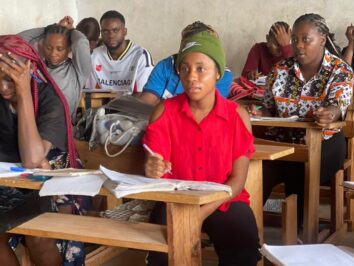
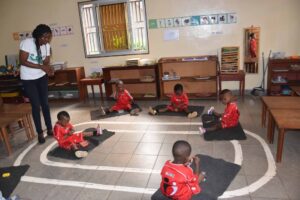
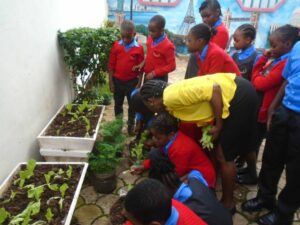
Children are given age-appropriate opportunities to choose purposeful activities, work with specially designed materials, repeat tasks until they gain mastery and increasingly manage responsibilities without unnecessary adult intervention.
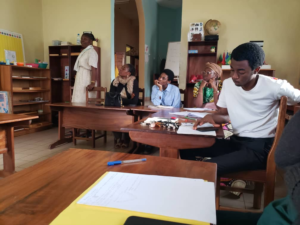
At Akwi Montessori School, the teacher therefore functions more as an observant guide than as an adult who constantly dictates every activity. The school's own description of its classrooms emphasises children selecting activities, working with them and returning them independently, while adults observe and intervene where necessary.
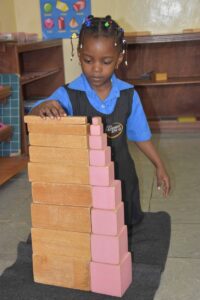
This reflects established Montessori practice. Association Montessori Internationale explains that Montessori materials are designed to support concrete exploration before children progress towards more abstract understanding. The approach deliberately encourages qualities such as independence, confidence, self-discipline, social connection and respect for others.
For a parent, that can translate into something surprisingly practical: a child gradually becoming more capable of saying, in effect, “I can try this myself.”
From Toddlers to Elementary: Education That Grows With the Child
One attraction of Akwi Montessori School is that Montessori education is not limited to preschool.
AMS currently caters for toddlers from approximately 2½ years, Montessori Nursery from 3 to 6 years, and Elementary learners from 6 to 12 years.
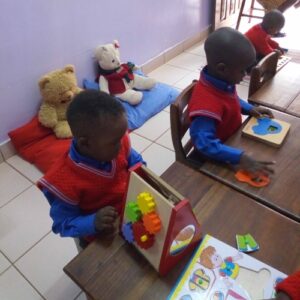
For toddlers, the school places particular emphasis on language, cognitive, emotional, social and motor development alongside independence. Children encounter age-appropriate Montessori materials and activities while learning to interact with both adults and other children in a nurturing environment.
At the 3–6 level, the Montessori approach becomes especially rich. International Montessori practice at this age incorporates Practical Life, Sensorial activities, spoken and written language, reading, mathematics and exploration of areas such as geography, biology, science, music and the arts. Children are encouraged to follow interests while developing concentration and increasingly sophisticated reasoning.
As children progress into Elementary at AMS, the approach continues while also recognising an important reality for families in Cameroon: many learners will eventually enter the national secondary education system.
Montessori Education With the Cameroonian Future in Mind
One question some Yaoundé parents naturally ask is whether a child educated through Montessori will be ready for Cameroon’s conventional examinations and secondary schools.
Akwi Montessori School Yaoundé has deliberately addressed this.
Although its educational philosophy is Montessori-based, AMS incorporates assessments as children mature and prepares eligible Elementary pupils for Cameroon’s Government Common Entrance and First School Leaving Certificate examinations. According to the school, this is intended to help learners function successfully within the wider Cameroonian education system should they continue their studies locally.
This balance is important.
Parents do not necessarily have to choose between nurturing independence and preparing a child for formal academic progression. AMS seeks to build the former while gradually preparing children for the latter.
For families thinking several years ahead—not merely about September 2026—that continuity can be a major consideration.
Small-Group Attention Without Making Children Dependent
Individual attention matters, particularly during the early years.
Akwi Montessori School currently reports an approximate ratio of seven pupils to one teacher across the school.
What is interesting about the Montessori approach, however, is that adult support is not intended to create adult dependence.
A teacher observes, introduces appropriate activities, helps when necessary and then gives the child space to work. Children are encouraged to develop the confidence and concentration required to complete increasingly complex tasks themselves.
This distinction matters because constant adult intervention may produce a child who waits for instructions before acting. Montessori instead aims to create an environment in which support and independence grow together.
An Anglo-Saxon School Where French Still Matters
Language is another significant factor when choosing a school in Yaoundé.
Akwi Montessori School identifies itself as an Anglo-Saxon institution, while French is taught throughout the school in recognition of Cameroon's bilingual context.
For families who value an English-language educational foundation but also want children to develop meaningful exposure to French, this provides an important local advantage.
It also reflects a broader principle behind successful education in Cameroon: children need strong academic foundations without being disconnected from the linguistic and cultural environment in which they are growing up.
Teachers Are Prepared for Montessori Practice
A Montessori school is only as effective as the adults who understand how to guide children within that environment.
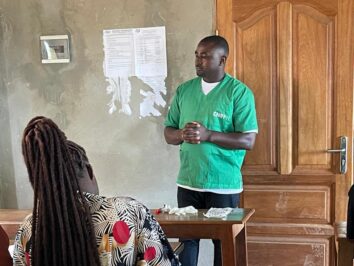
AMS states that teachers entering the school receive foundational Montessori training in its theory and the use of key materials before the academic year begins. Training then continues through sessions organised during the school year.
This is particularly important because Montessori teaching requires a different mindset from simply standing before a classroom and delivering information.
The Montessori educator observes carefully, recognises developmental needs, connects each learner with suitable materials and knows when to assist—and when to allow the child to discover independently.
For the 2026/2027 academic year, that philosophy places teacher preparation at the centre of the learning experience rather than treating it as an afterthought.
Independence Is Not the Same as Leaving Children Alone
This is one of the most common misunderstandings about Montessori education.
Giving children freedom does not mean allowing them to do anything they want.
An authentic Montessori environment combines freedom with structure, carefully established limits, order, respect for others and responsibility for materials and surroundings.
The environment itself is deliberately organised so that children can function with increasing independence. Furniture and resources are accessible, activities have purposes, and children are expected to respect both their work and the community around them.
The goal is not simply a child who can work alone.
It is a child who gradually develops the judgement to make choices, complete tasks, correct mistakes, respect others and take responsibility.
Those are skills that remain valuable long after a school examination has been forgotten.

Parents Remain Part of the Learning Journey
Choosing Montessori also asks something from parents.
A child's growing independence works best when the values promoted at school are understood at home.
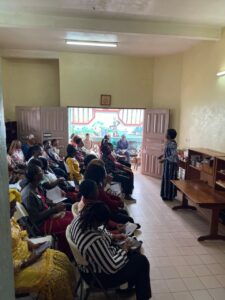
Akwi Montessori School encourages parents to interact with teachers about their children's development and provides opportunities such as parent information sessions. Parents may also arrange visits to observe their children at school.
This school-family relationship can be particularly valuable during the beginning of a new academic year, when younger children may be adapting to unfamiliar routines and older pupils are entering a new phase of development.
Instead of treating education as something that happens behind the school gate, parents can better understand how their children are learning and how to reinforce appropriate independence at home.
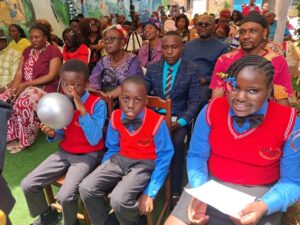
A School With Roots in Yaoundé
Akwi Montessori School was founded in 2007, giving it nearly two decades of experience by the beginning of the 2026/2027 school year.
Its founder, Prof. Estella Tembe-Fokunang, trained in Montessori education before establishing the school in Cameroon. According to AMS, the name “Akwi” honours her mother and her commitment to educating all her children, including her daughters.
That history gives the school's identity a distinctly Cameroonian dimension.
Montessori may be an internationally recognised educational philosophy, but a child attending school in Yaoundé also needs to understand the society, languages, traditions and academic system around them.
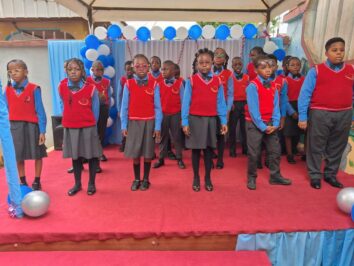
AMS has demonstrated this local orientation through cultural activities as well. Its published event history, for example, describes Cultural Day as an opportunity for pupils to explore and celebrate traditions from Cameroon's major cultural zones.
Preparing Your Child for School Resumption 2026/2027
School resumes at AMS on August 31st 2026. Back-to-school preparation should begin before the first morning at the gate.
For families considering Akwi Montessori School, the most useful steps are practical: begin the admission process early, arrange a school visit, allow your child to experience the environment and speak directly with the school about expectations for the coming academic year.
Parents can also begin encouraging simple independence at home—allowing children to organise personal belongings, complete manageable household tasks, make appropriate choices and take responsibility for routines rather than doing everything for them.
These small habits make the transition into a Montessori environment more natural.
Most importantly, parents should obtain the current 2026/2027 academic calendar, fee structure and resumption information directly from AMS before making payments or final arrangements. The fee page currently available on the school's website is labelled for the 2025/2026 academic year, so older figures should not automatically be assumed to apply to 2026/2027.
Also read Akwi Montessori School End-of-Year Graduation Ceremony 2026
How Admission to Akwi Montessori School Works
AMS accepts pre-registration applications throughout the year.
For a new pupil, the process begins with a pre-registration application. The school then arranges a visit so that staff can meet the child, introduce the Montessori environment and assess readiness. New parents also take part in an interactive session with the Head of School so that the family's expectations and the school's educational approach can be discussed before an admission decision is made.
This is more than an administrative procedure.
It allows parents to determine whether Montessori is genuinely the environment they want for their child, while giving the school an opportunity to understand each prospective learner before enrolment.
That is a far stronger foundation than choosing a school solely because of an advertisement.
Where Is Akwi Montessori School Located?
Akwi Montessori School is located at No. 130/156, Rue 8633, Maetur, Damas, Nsimeyong III, Yaoundé, Cameroon. Its official website currently provides online pre-registration options for both new and returning pupils.
Parents interested in the 2026/2027 school resumption at Akwi Montessori School can visit the campus, contact the school for current admission information or begin the pre-registration process through the official website.
For enquiries relating to current school communications, parents may also contact +237 677 20 77 12.
Is Akwi Montessori School the Right Choice for Your Child?
There is no single educational model that every family must choose.
What matters is finding an environment aligned with the kind of learning and development you want for your child.
Parents who want children to spend their early years simply memorising information may have many options in Yaoundé. Parents looking for a more child-centred environment—where academic learning develops alongside independence, concentration, confidence, practical ability and personal responsibility—may find Montessori education particularly compelling.
Akwi Montessori School adds another important dimension: it offers that philosophy within the realities of Yaoundé and the Cameroonian education system.
For families preparing for the 2026/2027 academic year, school resumption therefore presents an opportunity to think beyond the next report card.
The better question may be:
Where will my child learn not only what to think, but how to learn, explore, communicate, take responsibility and confidently do more for themselves?
For parents asking that question, Akwi Montessori School deserves a closer look.
Enrolment for the 2026/2027 Academic Year
Parents considering Toddler, Nursery or Elementary education in Yaoundé are encouraged to begin enquiries and pre-registration early. AMS admits children from approximately 2½ years through 12 years, subject to its admission process and availability.
Akwi Montessori School
Maetur, Damas – Nsimeyong III, Yaoundé, Cameroon
More information: +237 677 20 77 12
Begin your enquiry with Akwi Montessori School
Knowledge at Your Finger Tips.