A new academic year always brings a mixture of excitement and serious decisions for parents. Back to School at Akwi Montessori School: What Parents Should Know About Akwi Montessori School admissions, Learning and the 2026/2027 Academic Year.
Uniforms can be bought. Books can be replaced. School bags can be changed. But one decision has a much longer impact: where your child will spend hundreds of hours learning, developing habits, building relationships and forming a view of what education means.
For families preparing for the 2026/2027 academic year in Yaoundé, Akwi Montessori School offers an alternative to a classroom model built mainly around listening, copying and memorising.
At Akwi Montessori School (AMS), children are encouraged to participate actively in their own development. They handle materials, make age-appropriate choices, work independently, learn through practical experience and gradually develop the confidence to do more for themselves.
And yet AMS is not disconnected from the realities of education in Cameroon. The school also prepares eligible pupils for national examinations and teaches French alongside its Anglo-Saxon educational programme.
So, as another school year begins at AMS on Monday 21st, August 2026, what exactly should parents know before enrolling?

Here is a practical guide to admissions, learning and preparing your child for the 2026/2027 academic year at Akwi Montessori School in Yaoundé.
First Things First: What Is Akwi Montessori School?
Akwi Montessori School is a private Montessori nursery and primary school located in Maetur, Damas, Nsimeyong III, Yaoundé.
The school was founded in 2007 by Prof. Estella Tembe-Fokunang, who trained in Montessori education after obtaining a Diploma in Montessori Education from the St Nicholas Training Centre in London.
AMS currently provides programmes for:
- Toddlers: approximately 2½ to 3 years
- Montessori Nursery: 3 to 6 years
- Elementary: 6 to 12 years
This allows a child to enter Montessori education at an early age and continue through the primary years rather than experiencing it only as a short preschool programme.
For parents searching for a nursery school in Yaoundé, a primary school in Damas, or a more child-centred educational system, this distinction is important.
Akwi Montessori School Admissions for 2026/2027: How the Process Works
One thing parents should understand early is that admission into AMS involves more than simply filling out a form and paying school fees.
The school's published admission process for new pupils contains several stages designed to help both the family and the school determine whether the environment is suitable for the child.
Step 1: Pre-register Your Child
Akwi Montessori School states that applications are accepted throughout the year.
Parents begin by completing a pre-registration form, which expresses their intention to enrol their child.
The school collects information required for its records and for understanding the child and family before arranging the next stage of the process.
For parents targeting the 2026/2027 academic year, there is a simple advantage to beginning early:
you give yourself time to understand the school before school-resumption pressure begins.
Parents can access the school's registration information through its official website.
Step 2: Your Child Visits the School
New pupils are not admitted solely on paperwork.
AMS schedules a school visit during which staff can meet the child, introduce them to the Montessori environment and assess how ready they are for that environment.
This is particularly useful for parents transferring a child from a conventional school.
A Montessori classroom can feel noticeably different. Children may have more freedom of movement, work with specialised materials and receive less constant whole-class instruction from an adult.
Allowing the child to experience the environment helps the school determine the most appropriate placement.
Step 3: Parents Meet the School
The admission process also includes an interactive session between new parents and the Head of School.
The goal is to make sure the expectations of the family and those of AMS are reasonably aligned before admission is finalised.
This stage should matter to parents.
Choosing a Montessori school because the classrooms look attractive is not enough. Parents should understand the philosophy they are choosing.
Montessori education asks adults to encourage independence rather than immediately doing everything for the child. It emphasises observation, purposeful activity, responsibility and learning at an appropriate developmental pace.
A family that understands those principles is better positioned to support the child at home.
Step 4: Admission Decision and Registration
AMS says its admission decisions consider several factors, including the child's school visit, the parent interview, existing class needs, pupil-to-teacher ratios and special educational needs requirements.
Once admission is offered, the required registration payment and documentation must be completed before the child begins school.
That makes early registration particularly sensible for families who already know AMS is among their preferred schools for 2026/2027.

What Happens Inside a Montessori Classroom?
For parents accustomed to conventional schooling, Montessori can initially look unusual.
The teacher may not spend the entire lesson standing in front of children.
Students may not all be doing exactly the same activity at exactly the same moment.
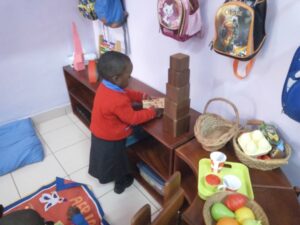
You may see one child working with numbers, another concentrating on a practical activity and another using carefully organised materials.
That is intentional.
The Association Montessori Internationale (AMI) explains that Montessori environments are deliberately prepared for child-centred learning. Furniture, work areas and developmental materials are made accessible so children can engage purposefully and progressively develop independence.
At AMS, the school describes adults as maintaining a more discreet presence, carefully observing children rather than constantly making themselves the centre of attention. Children learn to select appropriate work, use materials and put them back independently.
That seemingly simple routine develops something valuable:
responsibility.
A child gradually learns that learning is not something an adult has to force upon them every minute.
Montessori Does Not Mean “Children Just Do Whatever They Want”
This misunderstanding deserves clearing up.
Montessori provides freedom, but it is freedom within an organised environment.
Children have choices, but those choices exist within carefully established limits and purposeful activities.
AMI describes Montessori environments as ordered spaces containing materials selected for particular developmental stages. Teachers introduce children to appropriate activities and then provide room for hands-on, self-directed learning.
The goal is not uncontrolled freedom.
The goal is to help children gradually develop:
independence, concentration, self-discipline, confidence, responsibility and respect for others.
For parents, that distinction is crucial.
A Montessori child is not being taught that there are no rules.
The child is learning how to function responsibly without needing an adult to command every action.

What Will Younger Children Learn?
The Toddler Programme
AMS provides a transition programme for children from approximately 30 months to 3 years.
At this stage, development involves much more than learning letters and numbers.
The school's toddler programme focuses on:
- Language development
- Cognitive development
- Emotional development
- Social development
- Motor coordination
- Independence
Children encounter age-appropriate Montessori materials and activities while being encouraged to explore, make simple choices and interact with other children and adults.
One of the most important goals is remarkably simple:
helping the child develop the ability to “do it by myself.”
For a young child, putting away an object, carrying something carefully, choosing an activity or completing a simple practical task can be an important developmental achievement.
Montessori Nursery: More Than ABC and 123
The 3–6-year period is one of the best-known stages of Montessori education.
At this age, learning typically combines practical life, sensory exploration, mathematics, language, movement, culture and social development.
AMI explains that the Montessori 3–6 environment uses real-life activities and concrete materials to support independence, concentration and intellectual development.
Activities typically cover areas including:
- Practical Life
- Sensorial development
- Spoken language
- Writing
- Reading
- Mathematics
- Geography
- Biology
- Science
- Music
- Arts
What makes this approach particularly attractive is the connection between academic knowledge and practical development.
A child is not only learning what something is.
They are learning how to observe, manipulate, compare, organise, question, correct themselves and persist.
Those behaviours become foundations for later academic learning.

What About Primary School and National Examinations?
This is one of the biggest questions Cameroonian parents ask about Montessori education:
Will my child still be able to cope with Cameroon’s mainstream education system?
AMS has deliberately incorporated this consideration into its programme.
Children can progress through Montessori Nursery into Lower and Upper Elementary, and children transferring from traditional schools can be assessed for placement at the appropriate level.
AMS also introduces assessments as pupils mature.
According to the school, eligible Elementary pupils may be prepared for the Government Common Entrance Examination and First School Leaving Certificate, helping them transition into Cameroonian secondary education when appropriate.
That gives parents an important combination:
Montessori learning during the formative years without ignoring the examination system their children may later encounter in Cameroon.
Will a Montessori Child Adapt to a Conventional Secondary School?
It is understandable for parents to think several years ahead.
A child may study at AMS now but later move into a conventional secondary school, international school or another education system.
The skills developed through Montessori—independent work, problem-solving, concentration and responsibility—are intended to help children become adaptable learners rather than pupils who can function only under one teaching style.
AMS acknowledges that moving between Montessori and conventional education can involve adjustment because the teaching methods differ. It therefore incorporates assessments and preparation for the Cameroonian system as children progress.
That is another reason parents should think of education as a developmental journey, not simply preparation for the next examination.
English-Based Education With French Included
Language matters enormously when choosing a school in Yaoundé.
Akwi Montessori School describes itself as an Anglo-Saxon institution, while French is taught throughout the school because it is one of Cameroon's official languages.
For many families, this is an attractive combination.
A child can develop within an English-speaking academic environment while still building familiarity with French—an important advantage in Cameroon’s bilingual national context.
What Is the Teacher-to-Pupil Ratio?
Parents considering schools for younger children often want to know whether their child will simply disappear into a crowded classroom.
AMS currently reports an average ratio of approximately seven children to one teacher throughout the school.
Montessori education, however, approaches adult support slightly differently.
The goal is not to place so many adults around the child that the child stops thinking independently.
Instead, teachers observe, guide, introduce materials, identify needs and intervene appropriately.
AMI describes the Montessori educator as a guide or facilitator who observes the child and connects them with the prepared environment rather than dominating the learning process.
Good support therefore means:
being available without making the child dependent.
Montessori Teachers Need More Than Conventional Teacher Training
Furniture and Montessori materials alone do not make a Montessori school.
Teachers have to understand why and how the method works.
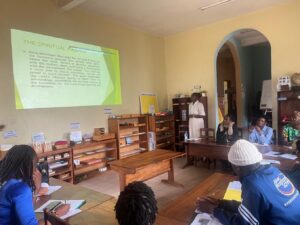
AMS states that its teachers are selected from qualified educators and receive foundational Montessori training before the academic year, including theory and the use of key materials. Training sessions continue during the school year.
This aligns with the broader Montessori principle of the “prepared adult.”
AMI stresses that Montessori educators require an understanding of child development, careful observation and knowledge of how to connect children with appropriate activities without unnecessarily taking over their learning.
That distinction matters enormously.
A Montessori classroom depends not only on what is available to the child, but on how the adult behaves around the child.
Parents Have a Role Too
Sending a child to a Montessori school does not make the parent irrelevant.
In fact, cooperation between school and home can make the experience much stronger.
AMS encourages parents to communicate with school staff about their children's development. Parents may also arrange visits to observe their children, and the school provides parent classes or information sessions during the year.
The home environment does not need to become a second classroom.
Simple changes can reinforce what the child is learning at school:
Give children age-appropriate responsibilities.
Allow them time to try before immediately helping.
Create accessible spaces for their belongings.
Encourage them to clean up after activities.
Let them participate in simple household tasks.
Allow reasonable choices.
Expect courtesy and respect.
Avoid completing every task simply because the adult can do it faster.
The result is consistency.
The message the child receives at school—“You are capable”—continues at home.
What Parents Should Confirm for the 2026/2027 Academic Year
One important warning for families researching AMS online:
always verify current academic-year information before making financial decisions.
At the time of writing, the fee page publicly available on the Akwi Montessori School website is specifically labelled 2025/2026. It should therefore not automatically be treated as the confirmed fee structure for 2026/2027.
Parents should directly confirm:
- The official 2026/2027 resumption date
- Registration deadlines
- Current tuition and registration fees
- Payment instalment options
- Required documents
- School supplies
- Uniform requirements
- Class placement
- Transport arrangements, where applicable
- Orientation or parent meetings
Do not allow an old screenshot, forwarded WhatsApp message or previous year's fee sheet to substitute for current school information.
For a new academic year, confirm directly with the school.

A Practical Back-to-School Checklist for AMS Parents
The weeks before school reopening should not become a race to buy everything at the last minute.
A smoother preparation plan looks like this:
1. Complete Admission Early
If your child is new to AMS, begin pre-registration early enough to complete the school visit and parent interview.
2. Confirm Your Child's Programme
Know whether your child is entering Toddler, Montessori Nursery, Lower Elementary or Upper Elementary.
3. Ask for the Current 2026/2027 Requirements
Request the latest fee information, supplies list, calendar and administrative requirements directly from the school.
4. Begin Restoring School Routines
During holidays, sleep and waking times can drift considerably.
Start adjusting bedtime and morning routines gradually before resumption.
5. Encourage Independence
For younger children especially, practise simple skills such as putting on shoes, carrying a bag, eating independently, organising belongings and cleaning up.
6. Talk Positively About School
Children often absorb adult anxiety.
Instead of repeatedly warning a child about how difficult school will be, help them see resumption as an opportunity to meet friends, explore and learn.
7. Label Important Belongings
Younger children may own similar bottles, lunch boxes, bags or clothing. Clear identification saves unnecessary confusion.
8. Communicate Important Information
If there is information the school needs to support your child appropriately, provide it through the school's established admission and communication procedures.
New to Montessori? Give Your Child Time
One mistake parents sometimes make is comparing a child's first few days in a Montessori environment with another child's experience.
Children adapt differently.
A toddler entering school for the first time may need emotional reassurance.
A five-year-old transferring from a highly teacher-directed school may initially wait for instructions.
An older pupil may need time to understand that greater freedom comes with greater responsibility.
Adjustment is part of the process.
Parents should pay attention to progress over time rather than expecting every child to respond identically on Day One.
Why the Learning Environment Matters
A prepared Montessori classroom is designed around the developmental needs of children.
Materials are accessible. Furniture is appropriate to the child's size. Activities have defined purposes. Children have space to work individually and collaboratively.
AMI explains that this organisation supports concrete exploration, practical ability and eventually more abstract knowledge.
The effect can go beyond academics.
An environment designed for children's independence constantly communicates:
This place belongs to you too. You are capable of participating in it responsibly.
That is very different from a classroom where almost everything is positioned for the convenience of adults.

Education for Life, Not Just Report Cards
Every parent wants their child to perform academically.
But good education also has to prepare children for situations that will never appear on an examination paper.
Can the child solve a problem?
Can they remain focused?
Can they communicate?
Can they take care of their belongings?
Can they work with other people?
Can they make an appropriate choice?
Can they try again after making a mistake?
Can they take responsibility?
Montessori education intentionally develops many of these behaviours alongside academic learning.
AMI identifies independence, responsibility, confidence, self-discipline and community participation among the outcomes fostered by properly prepared Montessori environments.
These qualities matter in Nursery.
They matter in Primary School.
And they will still matter when that child eventually enters university, employment and adult life.
Where Is Akwi Montessori School Located?
Akwi Montessori School's official website lists its location as:
No. 130/156, Rue 8633
Maetur, Damas
Nsimeyong III
Yaoundé, Cameroon
The school's website also provides pre-registration links for new and returning pupils.
Frequently Asked Questions About Akwi Montessori School
What age can a child start at Akwi Montessori School?
AMS admits toddlers from approximately 2½ years, Nursery pupils from 3–6 years, and Elementary pupils from 6–12 years.
Can my child transfer from a traditional school?
Yes. AMS states that children from traditional schools can be admitted after an assessment to determine the appropriate level.
Does Akwi Montessori School prepare pupils for national examinations?
Yes. Eligible Elementary pupils may be prepared for the Government Common Entrance Examination and First School Leaving Certificate.
Is Akwi Montessori School bilingual?
AMS describes itself as Anglo-Saxon, with French taught throughout the school.
Can parents visit before enrolling?
Yes. A school visit forms part of the admission process for new pupils, and prospective parents also participate in an interactive session with the Head of School.
Are applications limited to one period of the year?
The school states that applications are accepted year-round, although availability and class needs are considered during admission decisions.
Are the fees currently displayed online for 2026/2027?
The fee page available during this review is labelled 2025/2026. Parents seeking admission for 2026/2027 should therefore request the current fee schedule directly from AMS rather than assuming the previous figures remain unchanged.
Also read AKwi Montessori School Excursion to RFIS
Ready for the 2026/2027 School Year?
The beginning of another academic year is a chance to do more than prepare a child's school bag.
It is an opportunity to ask what kind of education will help that child become capable, curious, responsible and confident.
At Akwi Montessori School, the answer is built around a simple but powerful principle: children are active participants in their own development.
They learn with their hands as well as their minds.
They gain freedom together with responsibility.
They receive guidance without unnecessary dependence.
And as they progress, they are prepared not only for academic requirements but for the wider world beyond the classroom.
For parents exploring Montessori education in Yaoundé for the 2026/2027 academic year, the best next step is not simply to read about AMS.
Visit. Ask questions. See the environment. Meet the school. And decide whether it is the kind of place in which you want your child to grow.
Enquiries and Pre-registration
Akwi Montessori School
Maetur, Damas – Nsimeyong III
Yaoundé, Cameroon
Start with the Akwi Montessori School website
2026/2027 admissions: Parents are encouraged to enquire early and confirm the current resumption date, fees and admission requirements directly with the school.
Akwi Montessori School — Knowledge at Your Finger Tips.